markdown
Uncensored WAN 2.2 Remix v2.1 in ComfyUI: Unleash Next-Level Consistency & Smooth Flow for AI Image-to-Video
The world of AI-generated content is constantly evolving, and the demand for realistic, high-quality image-to-video transformations is skyrocketing. Enter the uncensored WAN 2.2 Remix v2.1 model, now seamlessly integrated with the powerful node-based interface of ComfyUI. This isn't just another incremental update; it's a leap forward in facial consistency, smooth motion handling, and overall video quality, opening up a universe of possibilities for both seasoned AI artists and newcomers alike. Whether you're exploring the boundaries of creative expression or simply seeking to elevate your AI video projects, WAN 2.2 Remix v2.1 in ComfyUI is a game-changer. This comprehensive guide will walk you through everything you need to know to harness its potential, from setup and workflow optimization to advanced prompting techniques and upscaling strategies. Get ready to experience a new era of AI-powered video generation.
What is WAN 2.2 Remix v2.1 and Why Should You Care?
WAN 2.2 Remix is a fine-tuned Stable Diffusion model known for its ability to generate highly detailed and realistic images. The "Remix" aspect implies modifications and improvements over the original Stable Diffusion architecture, often focusing on specific aesthetic styles or enhanced capabilities. The "uncensored" designation, while carrying certain connotations, primarily indicates the model's ability to generate content that might be restricted by other models due to ethical or safety guidelines.
Version 2.1 brings crucial improvements, particularly noticeable in:
- Enhanced Facial Consistency: Previous AI video generation models often struggled with maintaining consistent facial features across frames, resulting in jarring and unrealistic transitions. WAN 2.2 Remix v2.1 significantly improves facial consistency, ensuring that characters retain their identity throughout the video.
- Smoother Motion Handling: This version excels at creating fluid and natural motion, reducing the "jittery" or "shaky" effects that plagued earlier models. This leads to a more immersive and believable viewing experience.
- Low-VRAM Optimization: Generating high-quality AI videos can be resource-intensive. WAN 2.2 Remix v2.1 is optimized for lower VRAM GPUs, making it more accessible to a wider range of users. This means you can achieve impressive results even without the most powerful hardware.
These improvements, combined with the flexibility and power of ComfyUI, make WAN 2.2 Remix v2.1 an exceptional tool for creating compelling AI-generated videos.
Setting Up ComfyUI for WAN 2.2 Remix v2.1
Before you can start generating stunning AI videos, you need to set up ComfyUI and integrate the WAN 2.2 Remix v2.1 model. Here's a step-by-step guide:
1. Install ComfyUI:
If you haven't already, download and install ComfyUI. The installation process varies depending on your operating system and hardware. Refer to the official ComfyUI documentation for detailed instructions:
- https://github.com/comfyanonymous/ComfyUI" target="_blank" rel="noopener noreferrer">ComfyUI GitHub Repository
2. Download the WAN 2.2 Remix v2.1 Model:
You can download the model from two primary sources:
- Hugging Face: https://huggingface.co/FX-FeiHou/wan2.2-Remix?not-for-all-audiences=true" target="_blank" rel="noopener noreferrer">https://huggingface.co/FX-FeiHou/wan2.2-Remix?not-for-all-audiences=true
- Civitai: https://civitai.com/models/2003153" target="_blank" rel="noopener noreferrer">https://civitai.com/models/2003153
Choose the source that you prefer. Download the model file (usually a .safetensors or .ckpt file). Be mindful of the "uncensored" nature of the model and ensure you comply with all applicable laws and regulations.
3. Place the Model in the Correct Directory:
Locate your ComfyUI installation directory. Within that directory, navigate to ComfyUI/models/checkpoints. Place the downloaded WAN 2.2 Remix v2.1 model file in this folder.
4. Download the Workflow (Optional but Recommended):
The provided workflow file (https://drive.google.com/file/d/16ILcDfho1S6bfdP4-D1dNNkLRmY8imcs/view?usp=sharing" target="_blank" rel="noopener noreferrer">https://drive.google.com/file/d/16ILcDfho1S6bfdP4-D1dNNkLRmY8imcs/view?usp=sharing) offers a pre-configured setup for generating images and videos with WAN 2.2 Remix v2.1. Download this file.
5. Load the Workflow in ComfyUI:
Open ComfyUI. Drag and drop the downloaded workflow file (.json or similar extension) onto the ComfyUI interface. This will load the entire workflow, including all the necessary nodes and connections.
6. Install Custom Nodes (If Required):
The workflow might rely on custom nodes that are not included in the default ComfyUI installation. If you encounter any errors related to missing nodes, you'll need to install them. Common custom node managers include:
- ComfyUI Manager: A popular extension that simplifies the installation and management of custom nodes. You can usually install it by cloning the repository into your
ComfyUI/custom_nodesdirectory.
Once you have a node manager installed, use it to search for and install any missing nodes. Pay close attention to the error messages in ComfyUI, as they will usually indicate the name of the missing node. The workflow mentioned using "Painter Nodes" which may require a separate installation.
7. Configure VAE (Variational Autoencoder):
Sometimes, a specific VAE is recommended for optimal results with a particular model. Check the model's Civitai page or Hugging Face repository for recommended VAEs and instructions on how to load and configure them in ComfyUI. The VAE file should be placed in ComfyUI/models/vae.
8. Restart ComfyUI:
After installing custom nodes and configuring the VAE, it's generally a good idea to restart ComfyUI to ensure that all changes are properly loaded.
Understanding the ComfyUI Workflow for WAN 2.2 Remix v2.1
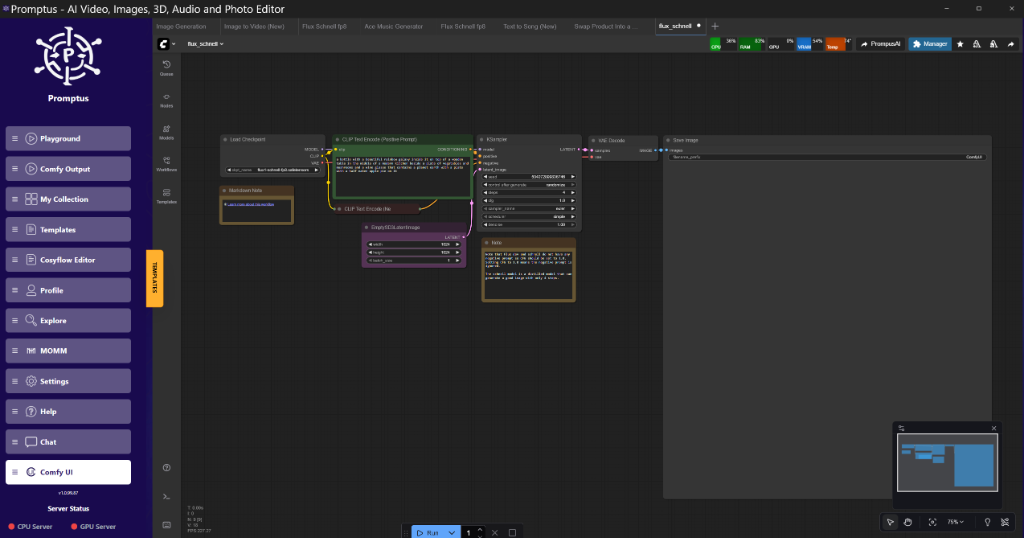
The ComfyUI workflow provides a visual representation of the image generation process. Let's break down the key components and how they interact:
1. Load Checkpoint:
This node loads the WAN 2.2 Remix v2.1 model. It specifies the model file that ComfyUI will use to generate images.
2. Text Prompts (Positive and Negative):
These nodes define the desired content of the image. The "positive prompt" describes what you want to see in the image, while the "negative prompt" specifies what you want to avoid (e.g., "blurry," "artifacts," "deformed").
Example Prompts:
- Positive: "A stunning portrait of a woman with vibrant red hair, detailed eyes, cinematic lighting, photorealistic"
- Negative: "blurry, distorted, artifacts, low resolution, bad anatomy"
3. Sampler:
The sampler node is responsible for the iterative process of generating the image based on the prompt and the model. Key parameters include:
- Sampler Type: Different samplers (e.g., Euler a, DPM++ 2M Karras) can produce varying results. Experiment to find the sampler that works best for your desired style.
- Steps: The number of iterations the sampler performs. Higher steps generally lead to higher quality but also increase generation time.
- CFG Scale (Classifier-Free Guidance Scale): Controls how closely the generated image adheres to the prompt. Higher values result in stronger adherence but can sometimes lead to artifacts.
- Seed: A random number that determines the initial state of the generation process. Using the same seed with the same prompt and settings will produce the same image.
4. KSampler (Advanced Sampler):
ComfyUI's KSampler node offers more advanced sampling options, including:
- Scheduler: Affects the sampling process. Common schedulers include "normal," "karras," and "exponential."
- Denoise: Controls the amount of noise added to the image during the sampling process.
5. VAE Decode:
The VAE (Variational Autoencoder) decode node converts the latent representation generated by the sampler into a visible image.
6. Save Image:
This node saves the generated image to your computer.
7. Image-to-Video Nodes (For Video Generation):
These nodes, which might include custom nodes like those mentioned utilizing "Painter Nodes" or other specialized video tools, are responsible for creating a sequence of images that form the video. They typically involve:
- Frame Interpolation: Generating intermediate frames to smooth out the transitions between keyframes.
- Motion Smoothing: Applying techniques to reduce jitter and create more fluid movement.
- Video Encoding: Converting the sequence of images into a video file.
Example Workflow (Simplified):
[Load Checkpoint] --> [Text Prompt (Positive)] --> [Text Prompt (Negative)] --> [Sampler] --> [VAE Decode] --> [Save Image]
^
|
[Empty Latent Image]
Crafting Effective Prompts for Uncensored WAN 2.2 Remix v2.1
Prompt engineering is crucial for achieving the desired results with any AI image generation model. Here are some tips for crafting effective prompts specifically for WAN 2.2 Remix v2.1:
- Be Specific: The more specific you are, the better the model can understand your vision. Instead of "a woman," try "a stunning portrait of a woman with vibrant red hair and piercing blue eyes."
- Use Descriptive Adjectives: Adjectives add detail and nuance to your prompts. Use words like "cinematic," "photorealistic," "detailed," "vibrant," and "dynamic" to enhance the image.
- Specify Lighting and Composition: Describe the lighting conditions (e.g., "golden hour," "dramatic lighting," "soft light") and the composition of the image (e.g., "close-up," "wide shot," "portrait," "landscape").
- Utilize Negative Prompts: The negative prompt is just as important as the positive prompt. Use it to specify what you don't want to see in the image. Common negative prompts include "blurry," "distorted," "artifacts," "low resolution," "bad anatomy," and "ugly."
- Experiment with Different Styles: WAN 2.2 Remix v2.1 is capable of generating images in a wide range of styles. Experiment with prompts that specify different art styles, such as "impressionistic," "cyberpunk," "anime," or "realistic."
- Incorporate Keywords: Research and incorporate keywords that are relevant to your desired subject matter. Websites like Lexica.art can help you discover effective keywords.
- Iterate and Refine: Don't be afraid to experiment with different prompts and refine them based on the results you get. The more you practice, the better you'll become at crafting effective prompts.
Example Prompts (Uncensored):
- Positive: "A hyperrealistic close-up of a woman's face, intricate details, perfect skin, cinematic lighting, sensual expression"
- Negative: "blurry, distorted, artifacts, low resolution, bad anatomy, clothing"
Important Considerations:
- Remember that "uncensored" models can generate content that is sexually suggestive, violent, or otherwise objectionable. Use these models responsibly and ethically.
- Always comply with all applicable laws and regulations regarding the generation and distribution of AI-generated content.
- Be mindful of the potential impact of your creations on others.
Optimizing Settings for Consistency and Smooth Flow
Achieving consistency and smooth flow in AI-generated videos requires careful attention to various settings within ComfyUI. Here are some key parameters to optimize:
- Seed Management: Use the same seed for each frame in a video sequence to ensure consistency. You can use a fixed seed or increment the seed by a small value for subtle variations.
- Denoising Strength: Adjust the denoising strength to control the amount of change between frames. Lower denoising strength generally leads to more consistent results.
- Frame Interpolation: Utilize frame interpolation techniques to generate intermediate frames and smooth out the transitions between keyframes. Many custom nodes offer frame interpolation capabilities.
- Motion Smoothing: Apply motion smoothing algorithms to reduce jitter and create more fluid movement.
- Resolution and Aspect Ratio: Choose a consistent resolution and aspect ratio for all frames in the video.
- Sampler and Scheduler: Experiment with different samplers and schedulers to find the combination that produces the most stable and consistent results. UniPC Beta, as mentioned, can be a good option.
- Upscaling: Use a consistent upscaling method for all frames to maintain visual quality and detail.
Advanced Techniques: Upscaling and Post-Processing
To further enhance the quality of your AI-generated videos, consider using upscaling and post-processing techniques:
- Upscaling: Upscaling increases the resolution of the video, resulting in sharper details and a more visually appealing image. Common upscaling methods include:
- ESRGAN: A popular AI-based upscaling model known for its ability to generate realistic details.
- Real-ESRGAN: An improved version of ESRGAN with enhanced performance and quality.
- Latent Upscaling: Upscaling in the latent space before decoding, which can sometimes produce better results.
- Post-Processing: Post-processing involves applying various effects and adjustments to the video after it has been generated. Common post-processing techniques include:
- Color Correction: Adjusting the colors to achieve a desired look and feel.
- Sharpening: Enhancing the sharpness of the image.
- Noise Reduction: Reducing unwanted noise and artifacts.
- Motion Blur: Adding motion blur to create a more cinematic effect.
ComfyUI allows you to integrate these techniques directly into your workflow using custom nodes.
Resources and Community
- ComfyUI GitHub Repository: https://github.com/comfyanonymous/ComfyUI" target="_blank" rel="noopener noreferrer">https://github.com/comfyanonymous/ComfyUI
- WAN 2.2 Remix Hugging Face: https://huggingface.co/FX-FeiHou/wan2.2-Remix?not-for-all-audiences=true" target="_blank" rel="noopener noreferrer">https://huggingface.co/FX-FeiHou/wan2.2-Remix?not-for-all-audiences=true
- WAN 2.2 Remix Civitai: https://civitai.com/models/2003153" target="_blank" rel="noopener noreferrer">https://civitai.com/models/2003153
- Civitai: A community-driven platform for sharing and discovering AI models, prompts, and workflows.
- Hugging Face: A hub for AI models, datasets, and applications.
- ComfyUI Subreddit: A Reddit community dedicated to ComfyUI.
- AI Art Discords: Numerous Discord servers are dedicated to AI art, where you can find helpful tips, tutorials, and community support.
- DFans: https://dfans.co?ref=4JS9BY" target="_blank" rel="noopener noreferrer">https://dfans.co?ref=4JS9BY - Explore decentralized platforms for AI creators.
Conclusion: Unleash Your Creative Potential with WAN 2.2 Remix v2.1 and ComfyUI
The uncensored WAN 2.2 Remix v2.1 model, combined with the flexibility and power of ComfyUI, represents a significant advancement in AI-generated image-to-video technology. With its enhanced facial consistency, smoother motion handling, and low-VRAM optimization, this combination opens up a world of possibilities for creators of all skill levels. By understanding the core concepts, mastering prompt engineering, and optimizing your workflow, you can unlock the full potential of WAN 2.2 Remix v2.1 and create stunning AI videos that were previously unimaginable.
Remember to use these powerful tools responsibly and ethically. Explore the boundaries of creative expression, but always be mindful of the potential impact of your creations.
Call to Action:
Now it's your turn! Download the WAN 2.2 Remix v2.1 model, set up ComfyUI, and start experimenting with different prompts and settings. Share your creations with the AI art community and inspire others to explore the exciting world of AI-generated video. Don't forget to like, comment what AI tool you'd like to see covered next, and subscribe for more ComfyUI tutorials! Your feedback helps shape future content and ensures that we continue to provide valuable resources for the AI art community.
📚 Explore More Articles
Discover more AI tutorials, ComfyUI workflows, and research insights
Browse All Articles →