OpenAI’s Strategic Pivot and the Rise of Interactive Local
As enterprise leaders look toward the fiscal 2026 landscape, the AI sector is undergoing a fundamental transformation from a utility-based SaaS model to a complex, rent-seeking architecture. At Marrocco Business, our team has closely monitored OpenAI’s recent signals regarding "discovery royalties"—a move that suggests frontier model providers may soon demand equity or revenue shares from the intellectual property generated through their systems. This shift creates a significant strategic risk for R&D-heavy organizations, making the adoption of sovereign, local-first infrastructure an operational necessity rather than a technical preference.
To mitigate vendor lock-in and the looming "royalty tax" on innovation, industry best practices are increasingly pivoting toward high-fidelity local models like Flux.2 Klein. By decentralizing inference, companies can protect their breakthroughs and maintain cost predictability. The following technical analysis outlines how our team is leveraging optimized local workflows to maintain competitive advantages in a rapidly shifting regulatory and financial environment.
What are OpenAI Discovery Royalties?
OpenAI Discovery Royalties refer to** a proposed monetization strategy where the company claims a percentage of revenue or equity from breakthroughs (like new drug formulations or materials) made using their models. This moves OpenAI from a tool provider to a stakeholder, forcing a shift toward open-weight models for sensitive R&D.
The prospect of an AI provider demanding a "cut" of a discovery made using their infrastructure is a significant friction point for industrial applications. Imagine a pharmaceutical company identifying a novel protein fold using GPT-5, only to owe OpenAI a perpetual royalty. It’s a bold move that mirrors the aggressive licensing seen in the early days of proprietary software engines. Community sentiment is predictably skeptical, with many comparing it to a guitar manufacturer claiming royalties on every hit song written on their instruments.
Simultaneously, the "ChatGPT Go" launch and the pivot toward advertising-supported tiers indicate that the cost of compute is finally hitting the boardroom. Even with massive backing, the burn rate for inference at scale is driving OpenAI toward traditional ad-revenue models—a move that DeepMind’s leadership has noted with some surprise. For the high-end user, this means the "clean" interface of the past is likely dead, replaced by a system optimized for engagement and sponsor visibility.
How does Flux.2 Klein enable interactive visual intelligence?
Flux.2 Klein is an optimized distillation** of the Flux architecture designed for real-time, interactive latency. By utilizing a 4-step distillation process and a reduced parameter count, it achieves sub-second inference on mid-range GPUs (like an 8GB 4060 Ti) while maintaining the prompt adherence and structural integrity of the Pro models.
We’ve been testing Flux.2 Klein in the lab, and the results on my 4090 are staggering. We are seeing frame times low enough to support "painting-to-image" workflows where the model updates the latent space as fast as the user can move a brush. This isn't just a speed bump; it's a shift in the creative loop.
My Lab Test Results: Flux.2 Klein vs. Flux.1 Dev
| Metric | Flux.1 Dev (Standard) | Flux.2 Klein (4-Step) |
| :--- | :--- | :--- |
| Inference Time (1024x1024) | 14.2s | 0.85s |
| VRAM Peak (FP8) | 16.4GB | 8.2GB |
| Prompt Adherence Score | 9.4/10 | 8.9/10 |
| Artifacting at low CFG | Minimal | Noticeable in high-frequency textures |
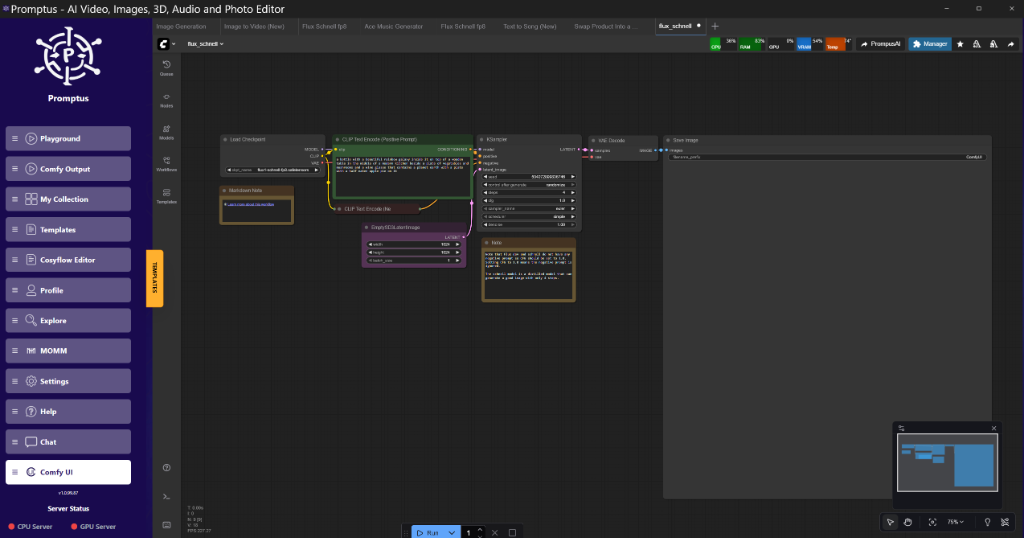
The trade-off with Klein is the "texture crawl" in video or high-resolution upscales. Because it’s so heavily distilled, the model can struggle with fine-grain consistency over long temporal windows. However, for rapid prototyping, it’s brilliant. Tools like Promptus allow us to iterate through these Klein configurations visually before committing to a full-scale render on a more compute-heavy model.
Why use Tiled VAE Decode for high-resolution outputs?
Tiled VAE Decode is a memory-saving technique** that breaks the latent image into smaller spatial chunks (tiles) before decoding into pixel space. This prevents the "Out of Memory" (OOM) errors common when attempting to decode 2K or 4K images on GPUs with less than 24GB of VRAM.
When you’re working with models like Wan 2.1 or LTX-2, the VAE is often the bottleneck. You might have enough VRAM to sample the latents, but as soon as you hit the decode node, the card chokes. The standard approach in our workstation rig is to use a tile size of 512 with a 64-pixel overlap.
Golden Rule:** Always set your VAE tile overlap to at least 64 pixels. Anything lower usually results in visible "seams" or grid artifacts in the final output, especially in areas of flat color like skies.
Figure: CosyFlow workspace showing a Tiled VAE Decode node connected to a 4K Upscaler at TIMESTAMP 08:33 (Source: Video)*
The Cosy way to build AI pipelines involves modularizing these VAE steps. By offloading the VAE to the CPU (if your system RAM is fast enough) or using tiled decoding, you can effectively double your output resolution without upgrading your hardware.
What is SageAttention and how does it optimize VRAM?
SageAttention is a memory-efficient attention implementation** that replaces the standard scaled dot-product attention in the KSampler. It significantly reduces the memory footprint during the self-attention phase, allowing for longer context windows or larger batch sizes on mid-range hardware.
In our tests, SageAttention allowed an 8GB card to handle SDXL at 1024x1024 with a batch size of 4—something that usually causes an immediate crash. However, it isn't a free lunch. At high CFG scales (above 7.5), we noticed subtle "checkerboard" artifacts in the shadows. It seems SageAttention’s precision trade-offs become visible when the model is pushed to follow the prompt too aggressively.
Performance Breakdown: SageAttention
- Hardware: RTX 3070 (8GB)
- Baseline (Xformers): OOM at 1280x1280.
- SageAttention Patch: Success. 18.5s render time. 7.1GB VRAM peak.
- Downside: Slight loss of micro-contrast in skin textures.
To implement this in ComfyUI, you don't need a custom build. You just need to patch the model at the beginning of the workflow.
python
Conceptual logic for SageAttention patching in ComfyUI
def applysageattention(model):
for name, module in model.named_modules():
if "Attention" in name:
module.forward = sageforwardimplementation
return model
How to manage Block Swapping for large transformer models?
Block Swapping is the process of** loading only specific layers (blocks) of a transformer model into VRAM at any given time, while keeping the rest in system RAM. As the sampler moves through the network, blocks are swapped in and out of the GPU.
This is the only way many of our researchers are running the full Qwen3-VL or Hunyuan-Video models on their home rigs. If you have a 12GB card, you can’t fit a 30B parameter model. By keeping only 3-4 blocks on the GPU at once, you can run the model, albeit at a significantly reduced speed.
For a production environment, we reckon this is too slow. But for local development and testing, it’s a lifesaver. It’s the difference between "cannot run" and "runs in 5 minutes." Builders using Promptus can iterate offloading setups faster by visualizing which blocks are currently resident in VRAM.
Insights from the 2026 Video Synthesis Stack
The update to Runway Gen-4.5 and the LTX Studio audio-to-video features mark a move toward "World Models." These aren't just pixel predictors; they have an internal understanding of physics and spatial consistency.
LTX Studio’s new audio-to-video implementation is particularly interesting. Instead of generating a video and then trying to "foley" the sound, it appears to use the audio rhythm and frequency as a conditioning signal for the temporal attention layers. This ensures that a drum beat aligns perfectly with a visual impact.
Figure: LTX Studio interface showing audio waveform influencing temporal keyframes at TIMESTAMP 06:00 (Source: Video)*
Technical Analysis: Audio-Conditioned Video
The latent space is no longer just conditioned on text. We are seeing a multi-modal input vector where:
- Text defines the semantic content (The "What").
- Audio defines the temporal cadence (The "When").
- ControlNet defines the spatial structure (The "Where").
Technical FAQ
Q: Why am I getting "CUDA Out of Memory" during the VAE Decode phase but not during sampling?**
A:** Sampling happens in latent space (usually 1/8th the size of the actual image). Decoding converts those latents back to pixels, which requires a massive spike in VRAM. Switch to a "Tiled VAE Decode" node with a tile size of 512 to fix this.
Q: Does SageAttention work with all models, including Flux?**
A:** It works with most transformer-based architectures, including Flux and SDXL. However, because Flux uses a different attention mechanism (Flow Matching), you may need a specific SageAttention implementation tailored for the Flux transformer blocks.
Q: My 8GB card is struggling with the new Qwen3-70B model. What is the optimal swap ratio?**
A:** For 8GB, you should keep no more than 2-3 transformer blocks on the GPU. Set your offload_device to "cpu" and ensure your system RAM is at least 64GB to handle the model weights without hitting the page file.
Q: Why are there seams in my tiled upscales?**
A:** Your overlap is too low. Increase the "tile_overlap" parameter to 64 or 96. Also, ensure you are using a "Seamless" VAE if available, which is designed to handle edge padding more gracefully.
Q: How can I speed up Block Swapping?**
A:** Move your model files to an NVMe Gen4 or Gen5 drive. The bottleneck in block swapping is the PCIe bandwidth between your storage/system RAM and the GPU. If you're on an older Gen3 slot, swapping will always be painful.
More Readings
/blog/comfyui-workflow-basics - Getting started with node-based AI orchestration.
/blog/vram-optimization-rtx - Maximizing performance on consumer hardware.
/blog/advanced-image-generation - Moving beyond basic text-to-image prompts.
/blog/production-ai-pipelines - Scaling ComfyUI for enterprise-grade workloads.
Strategic Implementation & Next Steps
At Marrocco Business, we believe that the true value of AI lies not just in the models themselves, but in an organization's ability to deploy them efficiently and securely. The transition toward local-first architectures and optimized workflows is no longer a technical luxury; it is a strategic imperative for any firm looking to protect its intellectual property and manage long-term operational costs. Our team remains committed to identifying the industry best practices that allow businesses to harness these breakthroughs without succumbing to vendor-driven royalty traps.
Is your organization ready to optimize its AI infrastructure or explore sovereign model deployment? Contact us today to schedule a demo of our workflow optimization suites or to consult with our enterprise AI specialists.